
81% said an easier-to-use treatment would motivate them to restart.1,a
A path to sleep apnea care
A conversation that guides them back.
Identify untreated obstructive sleep apnea (OSA) patients, ask about barriers, and agree on a practical next step.

Re-engagement potential
Motivations for trying again

78% said reducing long-term health risks would motivate them.1,a

73% said a treatment that fits better into their daily routine would motivate them.1,a

67% said more support or follow-up from a healthcare professional (HCP) would motivate them.1,a
Surveyed adults with untreated OSA.
Tools for your team
Finding the patients who stopped OSA treatment
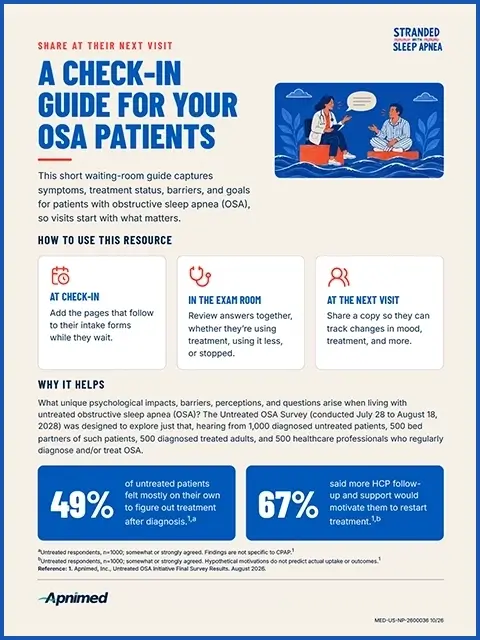
Free download
Give patients a place to start before their visit.
The Check-in Guide for Your OSA Patients helps people with OSA reflect on their experience and what they want from care. Share it before an appointment so patients can arrive better prepared to discuss their concerns and make their priorities part of the conversation.
Get the patient handout
Hear from the sleep apnea experts
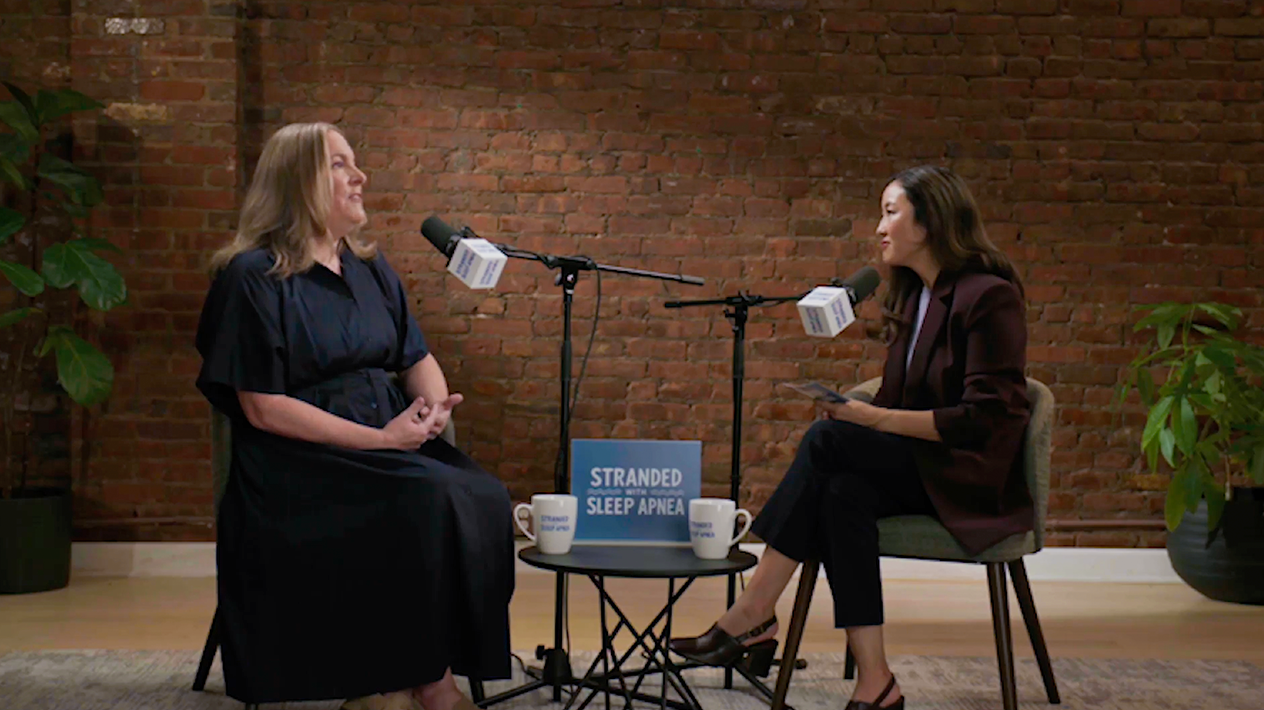
The part nobody warned me about
Dr. Cheri Mah and Emma Cooksey, Sleep Apnea Program Manager at Project Sleep, talk about what sleep apnea touches that a sleep study doesn’t show, and what makes it easier for patients to talk about it honestly.
Read video transcript
The part nobody warned me about — Transcript
Featuring Emma Cooksey, with host Dr. Cheri Mah.
Emma Cooksey: I was on this trip of a lifetime with amazing blue water and colorful fish and all of this, you know, amazing surroundings. But I didn't really feel like I was there, truly experiencing it.
[Title card: The part nobody warned me about — A Stranded With Sleep Apnea conversation]
Dr. Cheri Mah: Hi, I’m Dr. Cheri Mah, a sleep physician and performance specialist and host of the Stranded With Sleep Apnea podcast series. Joining me today is Emma Cooksey, a Project Sleep patient advocate and experienced podcast host who has spent years creating space for people to talk candidly about sleep apnea. Now she's here to help us understand what doesn't always appear in a sleep study, and what often doesn't come up in a doctor's appointment.
[Lower third: Cheri D. Mah, MD, MS | Host, Stranded With Sleep Apnea | Sleep physician and performance specialist]
Dr. Cheri Mah: Can you kind of unpack that a little bit more of what it was like before you got diagnosed, and how that was impacting your day to day?
Emma Cooksey: So at work, I dealt with so much daytime sleepiness that I would have to excuse myself for meetings to go splash water on my face just to wake up. More often than not, in that period, I was kind of blaming myself. Like I didn't really know what was wrong, but I knew that I couldn't keep up with everybody else.
[Lower third: Emma Cooksey | Sleep Apnea Program Manager, Project Sleep]
Dr. Cheri Mah: Now, in the untreated sleep apnea survey, where they looked at a thousand patients who are diagnosed with sleep apnea yet are untreated, there is a large percentage, 84% say that they feel that sleep apnea is stigmatized in the general public. How does that resonate with you?
[On-screen text: Based on a survey of 1000 adults with untreated obstructive sleep apnea (OSA). Stigma: any level, from slightly to significantly stigmatized, among the general public. Responses were self-reported and subject to recall and response bias. Adults self-identified as being diagnosed with OSA.[1]]
Emma Cooksey: That doesn't surprise me at all. Soon after I got my diagnosis, I came face to face with this. When I was at a cookout in our neighborhood and one of our neighbors was asking how I was and what was new with me, and I told him that I had just been diagnosed with sleep apnea. And I'll never forget he said, oh, I didn't know that was something that women could have. Isn't that something that big old truckers have? And he was just making a joke, and it seemed fairly harmless, but it was enough to make me kind of embarrassed and and question like, oh, maybe this isn't the most feminine thing to be diagnosed with.
Dr. Cheri Mah: So I want to talk a little bit about how you viewed yourself or what you’ve heard from other individuals who have apnea.
Emma Cooksey: I was less and less confident at work and started taking on less challenging roles just because I was struggling so much. I hear that from a lot of people that it just kind of undermines your self-confidence in a way.
Dr. Cheri Mah: Do you have advice for someone who might be in that position or recently received the diagnosis and are kind of sitting with it and processing it and figuring out what to do?
Emma Cooksey: So people feel so alone. And I guess the main message I want people to hear is that they're absolutely not alone in this diagnosis.
Dr. Cheri Mah: Discover the impacts of untreated sleep apnea on patients and those around them at strandedwithsleepapnea.com.
[On-screen text: Ask about the impact a sleep study doesn’t show.]
[End card: Stranded With Sleep Apnea logo. Visit StrandedWithSleepApnea.com to learn more. Social media icons: Facebook, Instagram, YouTube, LinkedIn, TikTok.]
[End matter: Sponsored by Apnimed. For educational purposes only. Not medical advice. Dr. Cheri Mah and Emma Cooksey are paid consultants of Apnimed, Inc. The Untreated OSA Survey (conducted July 28 to August 18, 2026) was an online survey of 1000 adults with diagnosed, untreated obstructive sleep apnea (OSA), 500 bed partners of such adults, 500 diagnosed treated adults, and 505 healthcare professionals who regularly diagnose and/or treat OSA. The survey’s goal was to understand the psychosocial impact, experiences, barriers, perceptions, and unanswered questions related to untreated OSA among those surveyed. Responses were self-reported and subject to recall and response bias. Adults self-identified as being diagnosed with OSA.[1] References: 1. Apnimed Inc., Untreated OSA Initiative Final Survey. August 2026. 2. Jordan AS, et al. Lancet. 2014;383(9918):736-747. 3. Balk EM, et al. Agency for Healthcare Research and Quality; 2022. Project ID: SLPT0919. MED-US-NP-2600042 11/26]
Ask for their experience
Identify their barriers, past and present

“What became hardest to manage?”
Explore the specific barrier before revisiting the plan.

“What would you most like to feel or do differently?”
Include energy, mood, relationships, and daily function in the discussion.

“What did you take away from your sleep study results?”
Connect oxygen findings and other results with the patient’s health concerns.

“What support would help you take the next step?”
Agree on one action and how the team will check back.
Let their partner join the conversation
With the patient’s permission, invite their partner to share observations about breathing, disrupted sleep, and daily symptoms. Ask how they would like to support the patient in starting and staying with care.

Stay informed

Get instant download access and ongoing updates on the latest in OSA
Explore our survey insights, clinician conversation guide, and check-in guide for your OSA patients to support your conversations about OSA care. Email updates will keep you in the loop with new findings, educational resources, and perspectives from experts.
About the survey
The Untreated OSA Initiative survey explored experiences with obstructive sleep apnea, treatment, and care. It was conducted online from July 28 to August 18, 2026.1,e
The survey included 3 perspectives: 1500 diagnosed patients (1000 untreated and 500 treated), 500 bed partners of untreated patients, and 505 healthcare professionals (HCPs) who regularly diagnose and/or treat OSA. Diagnosis and treatment status were self-reported by consumers. The untreated definition permitted positional or myofunctional therapy.1,e
Findings reflect respondents’ reports and, where noted, HCP estimates. Different questions used different groups and response thresholds. These findings are not national prevalence estimates and do not establish cause and effect.
Notes
- a. Untreated survey respondents n=1000; somewhat or strongly agreed. Hypothetical motivations do not predict actual uptake or outcomes.1
- b. Return estimate: HCPs, n=505; a clinician estimate, not tracked return rates.1
- c. Follow-up: HCPs involved in treatment decisions, n=481; includes inconsistent, provider-dependent, patient-initiated, and no formal approaches.1
- d. Bed partners, n=500; somewhat or strongly agreed. This is an expectation, not an observed treatment benefit.1
- e. The survey included 3 perspectives: 1500 diagnosed patients (1000 untreated and 500 treated), 500 bed partners of untreated patients, and 505 healthcare professionals. Diagnosis and treatment status were self-reported. The untreated definition permitted positional or myofunctional therapy.1
Reference
- Apnimed, Inc., Untreated OSA Initiative Final Survey. August 2026.
Last Updated on October 2026. Medically reviewed and approved by Apnimed.