
1000 adults with diagnosed untreated OSA1
Untreated OSA takes its toll
When untreated OSA patients drift from care, the burden remains.
Explore why patients disengage from obstructive sleep apnea (OSA) treatment, what remains at stake, and how to reopen the conversation.

New patient insights
Thousands surveyed about the realities of untreated OSA1
The Untreated OSA Initiative, conducted in partnership with Project Sleep and the Alliance of Sleep Apnea Partners (ASAP), surveyed 2505 people across the OSA care journey from July 28 to August 18, 2026. It covered 4 groups: patients with untreated OSA, patients currently in treatment, bed partners of untreated patients, and healthcare professionals who regularly diagnose and/or treat OSA. The findings center on patients who were diagnosed and are no longer being treated.1

500 adults with diagnosed OSA currently in treatment1

500 bed partners of untreated patients1

505 healthcare professionals1
Total respondents n=2505. Diagnosis and treatment status were self-reported.1
Healthcare professionals who regularly diagnose and/or treat OSA, n=505: sleep specialists (n=202, 40%), primary care physicians (n=203, 40%), and other specialists (n=100, 20%).1
Before the first prescription
Many don’t realize what snoring could mean
Snoring and daytime symptoms can become familiar long before a patient seeks care. A partner or clinician may be the first to raise the concern.1,2

only22% suspected their symptoms were something more than snoring before diagnosis.1
1in3 snored for 5 or more years before receiving a diagnosis.1
Untreated survey respondents n=1000.

Free download
See what happens after the diagnosis.
Survey Insights brings together patient, bed partner, and healthcare professional perspectives on life with untreated OSA. Share the findings with your team to better understand why patients step away from care and where they may need more support to return.
Get the survey insightsUnderestimating the risk
See where care can break down
Many untreated patients we surveyed underestimated their risk: most agreed that treatment didn't feel urgent for at least one reason, and more than a third chose "only people with severe OSA" as most likely to develop serious complications.
Risk perception
76% of surveyed untreated patients agreed with at least 1 reason treatment didn't feel urgent.1
36% of surveyed untreated patients chose "only people with severe OSA" when asked who is most likely to develop serious complications.1
Untreated respondents, n=1000. Urgency: somewhat or strongly agreed with at least 1 of 6 statements. Perceived risk is not measured clinical risk. Disease severity of untreated respondents: 44% mild, 45% moderate, 6% severe, and 5% unsure.
Treatment experience
Disengagement
52% became inconsistent with nightly use within 6 months.1
Untreated respondents who previously used PAP or an oral appliance, n=743, asked how long they used it nightly before skipping nights or removing it during the night.
70% had never seriously planned or taken steps to restart treatment.1
Untreated respondents n=1000; includes those who considered restarting without taking steps and those who had not considered it.
CPAP = continuous positive airway pressure
Hear from the sleep apnea experts
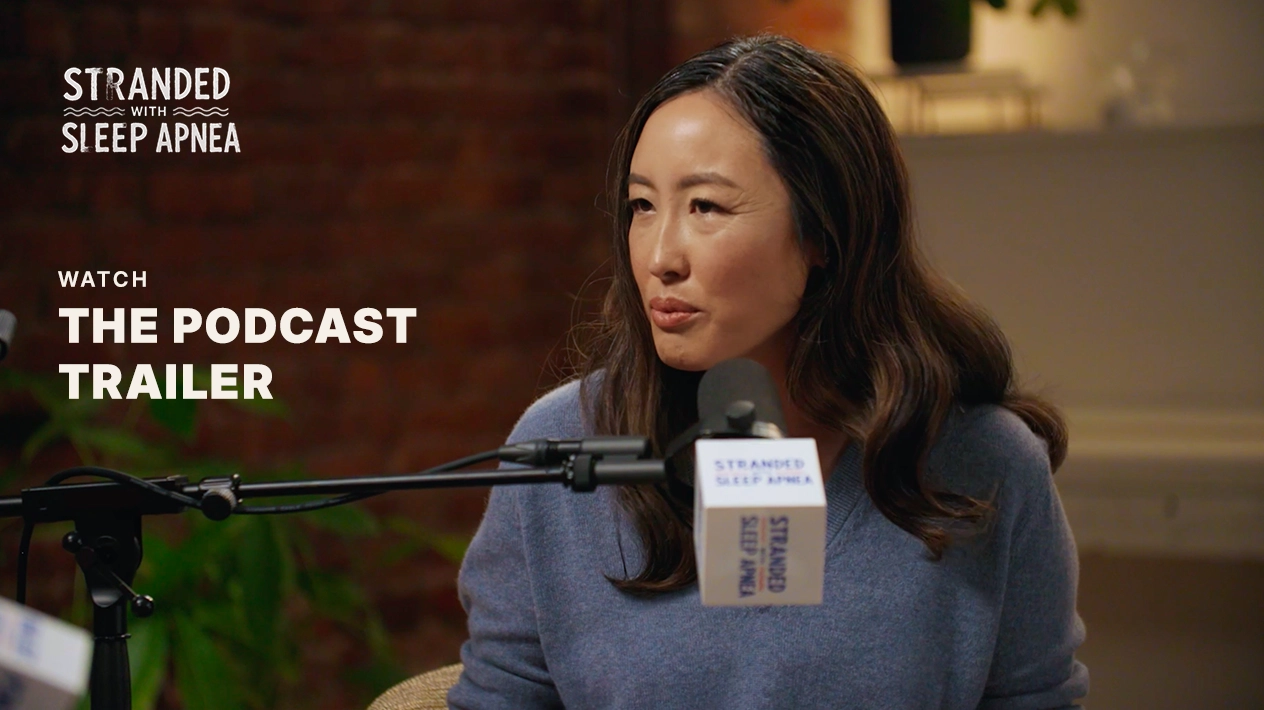
Watch the Stranded with Sleep Apnea podcast trailer
Get a first look at the Stranded with Sleep Apnea podcast as Dr. Cheri Mah brings together sleep experts and patient advocates to talk about what it actually feels like to live with sleep apnea, and why it's worth talking about.
Read video transcript
Stranded With Sleep Apnea — KOL Podcast Trailer (30 sec) — Transcript
Featuring Emma Cooksey, Dr. Reena Mehra, Dr. Chris Allen, Dr. Alison Kole and Dr. Neomi Shah, with host Dr. Cheri Mah.
Emma Cooksey: …fell asleep at the wheel with my baby in the car.
[Lower third: Emma Cooksey | Sleep Apnea Patient, Project Sleep Advocate and Podcast Host]
[On-screen text: fell asleep at the wheel with my baby in the car]
Dr. Reena Mehra: …you just become calibrated to that way of living.
[Lower third: Dr. Reena Mehra, MD, MS | Professor and Head of Pulmonary, Critical Care and Sleep Medicine, University of Washington]
[On-screen text: you just become calibrated to that way of living]
Dr. Cheri Mah: [Host segment, approx. 0:08–0:14 — spoken audio, no on-screen caption; wording to be confirmed from audio.]
[Lower third: Dr. Cheri D. Mah, MD | Sleep Physician and Performance Specialist, and Podcast Host of Stranded with Sleep Apnea]
Dr. Chris Allen: …you still feel the effects of it.
[Lower third: Dr. Chris Allen, MD | Sleep Specialist and Pediatric Neurologist]
[On-screen text: you still feel the effects of it]
Dr. Cheri Mah: [Host segment, approx. 0:20–0:22 — spoken audio, no on-screen caption or lower third; wording to be confirmed from audio.]
Dr. Alison Kole: It’s a true medical disorder that carries with it serious implications.
[Lower third: Dr. Alison Kole, MD, MPH, FFCP, FAASM | Sleep Specialist and Pediatric Neurologist, Oak Health Sleep Program]
[On-screen text: It’s a true medical disorder that carries with it serious implications]
Dr. Neomi Shah: Don’t make sleep the first thing you sacrifice.
[Lower third: Dr. Neomi Shah, MD, MPH, MSc | Professor of Medicine, Icahn School of Medicine at Mount Sinai]
[On-screen text: Don’t make sleep the first thing you sacrifice]
[End card: Follow @StrandedWithSleepApnea to catch every new episode as it’s released. StrandedWithSleepApnea.com. Social media icons: Facebook, Instagram, YouTube, LinkedIn, TikTok.]
[End matter: MED-US-NP-2600029]
The patient perspective
Ask what made continuing difficult
Treatment fit, routine demands, and support gaps can all drive patient disengagement. One specific question may open the door to a more useful conversation: “What was hardest to manage after you started OSA treatment?”1
46%
wished they could treat their sleep apnea but hadn't found an option that works for them.1
Untreated respondents n=1000; somewhat or strongly agreed.

The human impact
Ask about life between visits
Daily function, confidence, and relationships can reveal what matters most to the patient, and what may motivate them to re-engage.

93% of surveyed untreated patients said OSA has at least a mild impact on their day-to-day life.1
72% of surveyed untreated patients agreed OSA affects their self-perception, confidence, or identity.1
75% of surveyed bed partners said OSA had affected their relationship.1
Daily impact and self-perception: untreated n=1000. Daily impact includes mild through dominant effects; self-perception reflects agreement with at least 1 of 7 statements. Relationship impact: bed partners n=500; any effect.
The science to strengthen your next conversation

Understand the burden of oxygen deprivation
Take a closer look at hypoxia, disease heterogeneity, and how OSA may present in your patients.
See the evolving science
Know the barriers to treatment
Use patient motivations and structured follow-up to guide patients to the treatment that’s right for them.
Put insights into practiceStay informed

Get instant download access and ongoing updates on the latest in OSA
Explore our survey insights, clinician conversation guide, and check-in guide for your OSA patients to support your conversations about OSA care. Email updates will keep you in the loop with new findings, educational resources, and perspectives from experts.
About the survey
The Untreated OSA Initiative survey explored experiences with obstructive sleep apnea, treatment, and care. It was conducted online from July 28 to August 18, 2026.1
The survey included 3 perspectives: 1500 diagnosed patients (1000 untreated and 500 treated), 500 bed partners of untreated patients, and 505 healthcare professionals (HCPs), who regularly diagnose and/or treat OSA (about 40% sleep specialists, 40% primary care physicians, and 20% other specialists). Diagnosis and treatment status were self-reported by consumers. The untreated definition permitted positional or myofunctional therapy.1
Findings reflect respondents’ reports and, where noted, HCP estimates. Different questions used different groups and response thresholds. These findings are not national prevalence estimates and do not establish cause and effect.1
References
- Apnimed, Inc., Untreated OSA Initiative Final Survey. August 2026.
- Epstein LJ, Kristo D, Strollo PJ Jr, et al. Clinical guideline for the evaluation, management and long-term care of obstructive sleep apnea in adults. J Clin Sleep Med. 2009;5(3):263-276.
Last Updated on October 2026. Medically reviewed and approved by Apnimed.