95% of surveyed bed partners said their own sleep was disrupted by their partner's sleep apnea.
For bed partners
Feeling stranded with your partner’s sleep apnea?
You hear the snoring and the pauses in breath. You might lie awake wondering whether to say something. You’re not alone. Learn what other partners told us, and how to share what you’ve noticed.
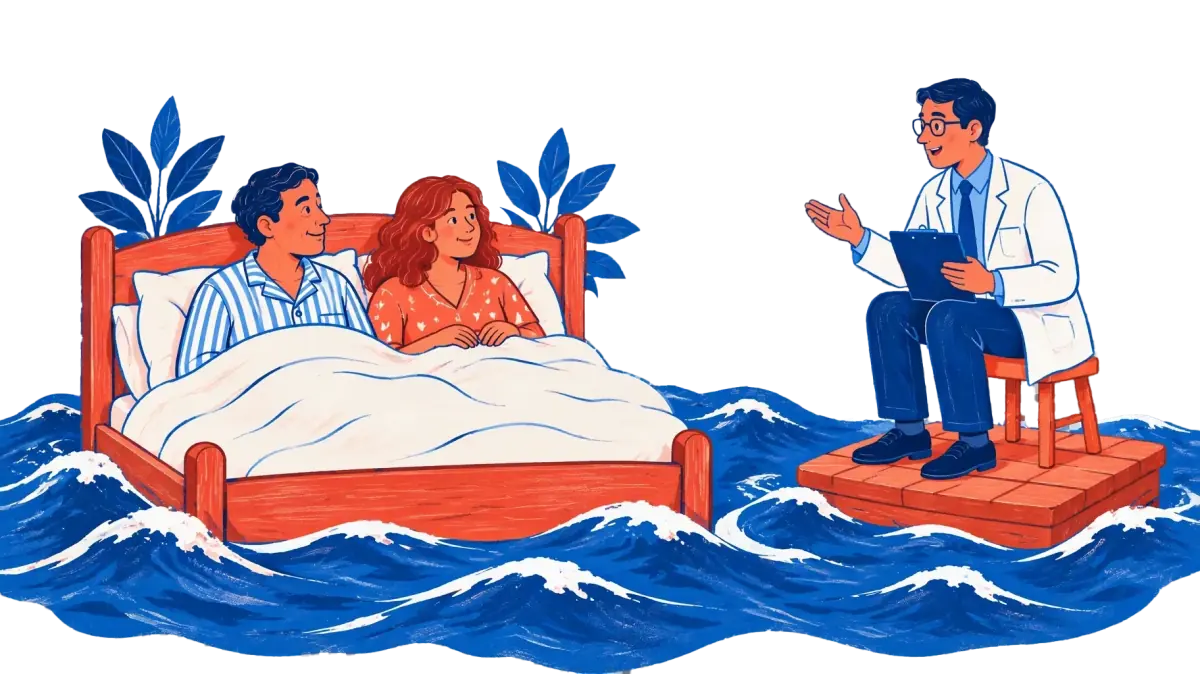
Your sleep matters, too
When did you last get a full night’s sleep?
Sleeping next to sleep apnea comes with its own kind of tired. The snoring, the pauses, the nights you lie awake listening for that next breath. In the Untreated OSA Initiative, we surveyed 500 bed partners about what those nights are like. If you’re worn out, frustrated, or worried, many of them felt just the same way.
75% said sleep apnea had affected their relationship.
40% sometimes or regularly sleep apart because of sleep apnea symptoms.
Bed partners of adults with untreated obstructive sleep apnea, n=500, were asked how often it disrupts their sleep (rarely to every night), how it has affected their relationship (any effect), and about their current sleeping arrangement (sometimes or regularly apart).
Your voice matters
A conversation can start with you
If you were the first to say something, nearly half of the partners we heard from were too.
48% of bed partners said they started the conversation about getting their partner diagnosed.
25% of bed partners said a healthcare provider started it.
12% of bed partners said their partner, the person with sleep apnea, started it.
Bed partners of people with untreated sleep apnea, n=500. Selected responses shown.
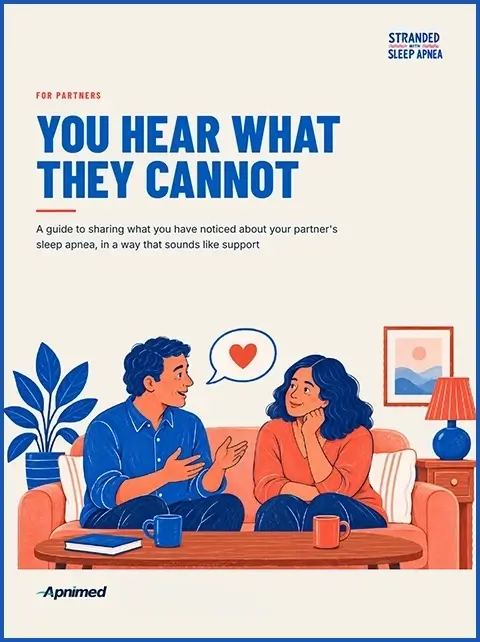
Free download
You’ve heard the pauses. Now find the words.
The Guide for Bed Partners helps you understand your partner’s experience with sleep apnea while making room for your own concerns. Find a thoughtful way to talk about what you’re both going through and support each other as you consider the next step.
Get the partner guide
More serious than snoring
Sleep apnea can impact their long-term health
Obstructive sleep apnea repeatedly blocks airflow during sleep and can lower oxygen levels. Left untreated, it increases the risk of serious health problems, including heart attack and stroke.
A conversation with their doctor can help your partner understand what their diagnosis means for their health.
Explore sleep apnea’s impactHear from the sleep apnea experts
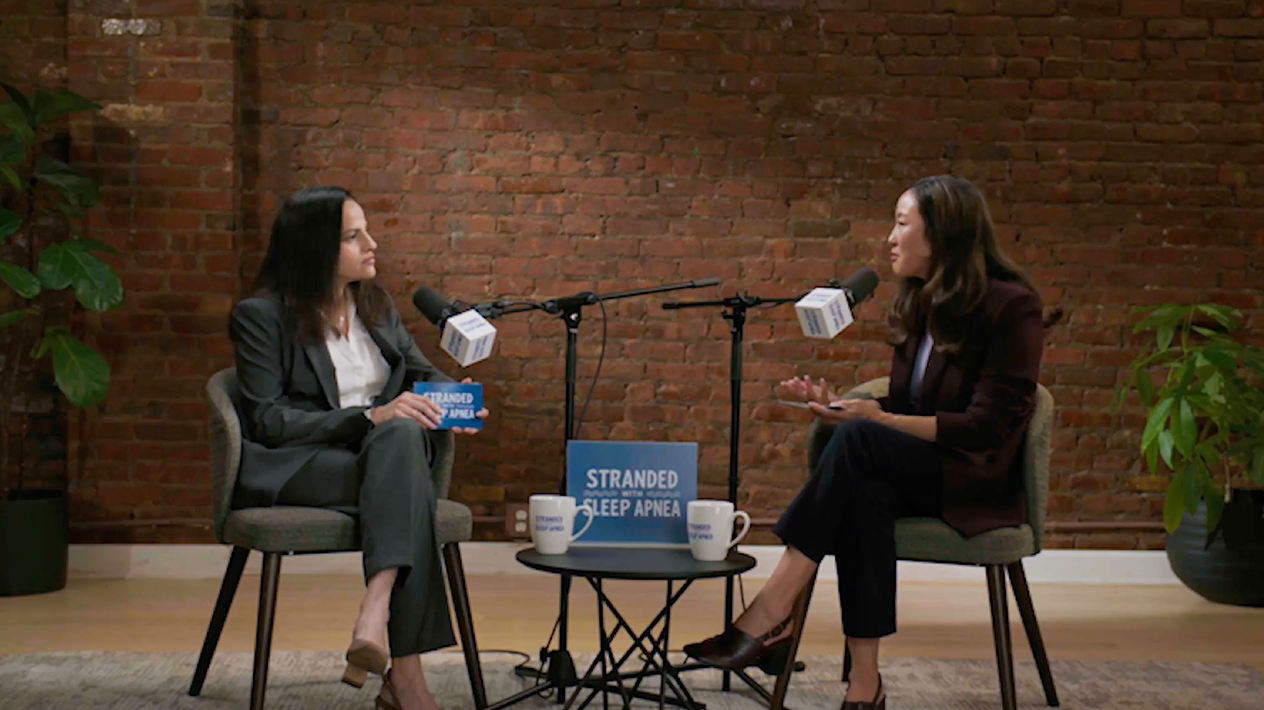
Fine, or just used to it? What sleep apnea can hide
Your partner says they sleep fine. You may have noticed otherwise. Watch as sleep experts Dr. Cheri Mah and Dr. Neomi Shah explain what you might be hearing at night and why it’s worth bringing up.
Read video transcript
Fine, or just used to it? What sleep apnea can hide — Transcript
Featuring Dr. Neomi Shah, with host Dr. Cheri Mah.
Dr. Neomi Shah: So the point is, you can get used to anything. …have you just gotten used to being tired, being sleepy, or are you truly fine?
[Title card: Fine, or just used to it? What sleep apnea can hide — A Stranded With Sleep Apnea conversation]
Dr. Cheri Mah: Hi, I’m Dr. Cheri Mah, a sleep physician and performance specialist and host of the Stranded With Sleep Apnea podcast series. Joining me is Doctor Neomi Shah, professor of medicine at the Icahn School of Medicine at Mount Sinai. She brings valuable insight into explaining what researchers actually mean by risk.
[Lower third: Dr. Cheri Mah | Host, Stranded With Sleep Apnea | Sleep physician and performance specialist]
Dr. Cheri Mah: Some researchers and doctors will talk about risk. You know, and I think that can be confusing to some people. So can you explain that a little bit to us?
Dr. Neomi Shah: Risk is information. And then you have ways to reduce that risk.
[Lower third: Dr. Neomi Shah | Professor of Medicine, Icahn School of Medicine at Mount Sinai]
Dr. Cheri Mah: Now some conditions, you know, kind of announce themselves and are a little bit more visible. And sleep apnea sometimes is not that.
Dr. Neomi Shah: Sleep apnea is occurring when you're asleep, right? So it's really hard for the person that's actually experiencing it to be aware of it, because it's happening for seven, eight, nine hours of their day when they're actually not aware of their environment or themselves. And so it's not uncommon for people to not know about it and for patients to come in having no idea. There is physiological consequences and health related consequences of poor sleep, fragmented sleep, and also having drops in oxygenation. All of those things are still happening when someone is asleep.
[On-screen text: Only 18% of adults surveyed with untreated obstructive sleep apnea (OSA) see leaving it untreated as very or extremely risky right now. 64% see the long-term risk. Based on a survey of 1000 adults with untreated OSA. Responses were self-reported and subject to recall and response bias. Adults self-identified as being diagnosed with OSA.]
Dr. Neomi Shah: So I feel fine today. Right. Some day is very hard to think about. An example that I give patients is hypertension, high blood pressure. Right. It's really not about having high blood pressure for a day, a week, a month. It's really over a course of years. And so sleep apnea is really doing things in the background to your overall health, specifically cardiovascular health that we just cannot feel. But it's it's happening.
[On-screen text: Sleep apnea is linked with high blood pressure, heart disease, stroke, and type 2 diabetes.]
Dr. Cheri Mah: What do you think someone is saying when they feel like they're just fine?
Dr. Neomi Shah: When I hear that, I feel fine. I interpret that as I've gotten used to it. Right. So we all can get used to things. You can get used to five hours of sleep. You can get used to pauses in your breathing. You can. Your bed partner can get used to the snoring. So the point is, you can get used to anything. And that could be, I'm fine, but it really needs to be investigated further in terms of, have you just gotten used to being tired, being sleepy, or are you truly fine?
Dr. Cheri Mah: What would you recommend that they talk to their clinician about beyond just like, what is my severity of sleep apnea?
Dr. Neomi Shah: Every patient is very unique, right. So really one size fits all approach is no longer applicable for sleep apnea. And the diagnostic pathway, you know, and the treatment pathways are really personalized. So you know, for example, you know, a middle aged man that comes in with an AHI of 50 who snores heavily and is extremely sleepy, is a very different patient than the same, the same AHI, right, a 25 year old woman who’s completely asymptomatic.
[On-screen text: AHI: breathing events per hour of sleep.]
Dr. Neomi Shah: I think the first question I would want the patient to ask is really what does it mean for them? Right. And as I said, what is this AHI of 15 mean for me, specifically me as opposed to an AHI of 15 for everyone, right?
Dr. Cheri Mah: Discover the impacts of untreated sleep apnea at strandedwithsleepapnea.com.
[On-screen text: When did you last wake up rested? If you have to think about it, mention it to your doctor.]
[End card: Stranded With Sleep Apnea logo. Visit StrandedWithSleepApnea.com to learn more. Social media icons: Facebook, Instagram, YouTube, LinkedIn, TikTok.]
[End matter: Sponsored by Apnimed. This video is for educational purposes only and is not medical advice. Talk with your healthcare provider about your health. Dr. Cheri Mah and Dr. Neomi Shah are paid consultants of Apnimed, Inc. The Untreated OSA Survey (conducted July 28 to August 18, 2026) was an online survey of 1000 adults with diagnosed, untreated obstructive sleep apnea (OSA), 500 bed partners of such adults, 500 diagnosed treated adults, and 505 healthcare professionals who regularly diagnose and/or treat OSA. The survey’s goal was to understand the psychosocial impact, experiences, barriers, perceptions, and unanswered questions related to untreated OSA among those surveyed. Responses were self-reported and subject to recall and response bias. Adults self-identified as being diagnosed with OSA. MED-US-NP-2600040 11/26]
Understanding their side
Why might they seem so calm about it?
Your partner may know sleep apnea can be serious but still feel that theirs is under control. Understanding that gap can help you meet your partner where they are.
76% of surveyed untreated patients agreed with at least 1 reason treatment didn't feel urgent, such as feeling their sleep apnea is under control.
51% of surveyed untreated patients feel they have their sleep apnea under control.
Untreated survey respondents, n=1000; somewhat or strongly agreed. The 76% includes agreement with at least 1 of 6 statements about control, managing without treatment, other health priorities, urgency, severity, or priority.
A path back to care
What would make trying again feel possible?
You hear what they cannot. Here is how to say it. If treatment was hard before, bringing it up again may feel discouraging. Start with what your partner wants to change.

“What was hardest about treatment for you?”
Start by listening to what made treatment difficult. Give your partner time to explain before offering suggestions.
“What would you want to be different this time?”
Ask what would make care easier to fit into everyday life. Encourage your partner to share those needs with their doctor.
“Would it help to write down what you want to ask?”
Offer to prepare questions together before an appointment. Let your partner decide whether they would like you to join the visit.
Stay informed
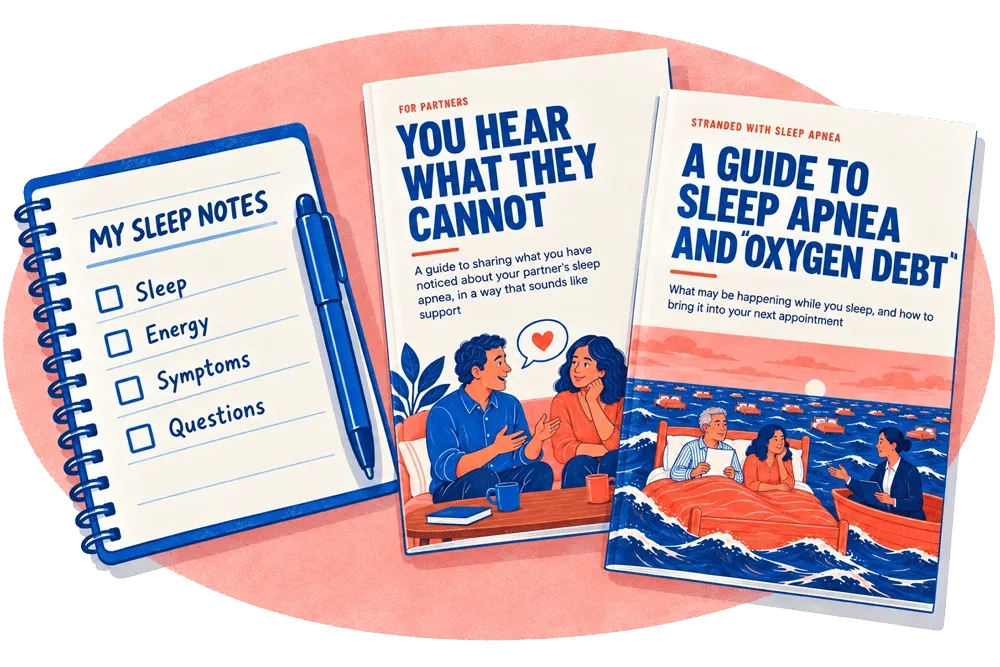
Get instant download access and ongoing updates starting today
Our free guides and survey highlights can help you understand your partner’s sleep apnea and find ways to talk about it together. Email updates will keep you in the loop with new resources and expert perspectives to support both of you along the way.
References
- Apnimed, Inc., Untreated OSA Initiative Final Survey. August 2026.
- Jordan AS, McSharry DG, Malhotra A. Adult obstructive sleep apnoea. Lancet. 2014;383(9918):736-747. doi:10.1016/S0140-6736(13)60734-5
Last Updated on October 2026. Medically reviewed and approved by Apnimed.